How AI-Accelerated Hardware Is Powering Smart Systems
How AI-Accelerated Hardware Is Powering Smart Systems
By Dreams Lab
Artificial Intelligence is no longer limited to cloud servers and research labs — it’s embedded in the world around us. From autonomous vehicles and facial recognition to smart surveillance and industrial robotics, the real-time intelligence we rely on is made possible by one critical advancement: AI-accelerated hardware.
As Pakistani industries begin to adopt smarter technologies — in manufacturing, agriculture, logistics, and fintech — understanding how AI-powered hardware works is no longer a luxury for engineers alone. It’s a strategic advantage for business leaders, innovators, and policymakers.
At Dreams Lab, we keep a close eye on the evolution of intelligent systems, and in this blog, we’ll break down:
- What AI-accelerated hardware is
- How it’s powering today’s smartest systems
- Why it matters for the future of business in Pakistan and globally
💡 What Is AI-Accelerated Hardware?
AI-accelerated hardware refers to specialized processors and architectures designed to handle the complex mathematical operations behind artificial intelligence, particularly machine learning and deep learning.
While traditional CPUs (central processing units) can handle AI workloads, they’re not optimized for parallel processing — the backbone of most AI computations.
That’s where AI hardware accelerators come in:
- GPUs (Graphics Processing Units) — Initially built for gaming, now essential for training AI models.
- TPUs (Tensor Processing Units) — Custom chips developed by Google for faster ML tasks.
- FPGAs (Field-Programmable Gate Arrays) — Reprogrammable chips suited for real-time inference.
- ASICs (Application-Specific Integrated Circuits) — Purpose-built for specific AI applications (e.g., edge AI, self-driving cars).
- Neuromorphic Chips — Inspired by the human brain to support ultra-low power AI tasks.
🔌 In short: AI accelerators make AI fast, efficient, and scalable — enabling smart systems to operate in real time.
🧠 Why Is This Hardware So Important?
Here’s the truth: AI algorithms are only as effective as the hardware that runs them.
Without accelerators:
- Deep learning models would take weeks to train.
- Real-time applications like object detection, voice recognition, or anomaly detection wouldn’t be possible.
- Devices like drones, robots, and smart cameras would be slow or battery-draining.
AI-accelerated hardware unlocks performance, allowing smart systems to:
- Process data faster
- Make real-time decisions at the edge
- Reduce energy consumption
- Scale across devices and use cases
⚙️ Hardware is the engine driving the next wave of intelligent applications.
🏭 Real-World Smart Systems Powered by AI Hardware
1. Smart Surveillance Systems
Modern CCTV systems don’t just record — they analyze.
- Detect faces, license plates, or suspicious behavior in real-time
- Send alerts without human review
- Operate on edge devices without cloud reliance
📍 Local relevance: Pakistani cities and malls are increasingly deploying smart surveillance with NVIDIA Jetson or Intel Movidius hardware.
2. Autonomous Vehicles & Drones
Self-driving systems require split-second decisions. AI accelerators:
- Process camera/LiDAR data
- Predict pedestrian movements
- Plan navigation routes — all in milliseconds
🚗 Tesla uses its own AI chip (Dojo), while others use NVIDIA DRIVE platforms.
📦 In Pakistan, drone startups in logistics and agriculture can leverage edge AI for real-time navigation and crop health analysis.
3. Industrial Automation & Predictive Maintenance
Factories with smart sensors can now:
- Detect machinery anomalies
- Predict failures before they happen
- Optimize energy use and workflow
All thanks to AI models running on edge computing devices powered by Intel or ARM AI chips.
🏭 Pakistan’s textile and manufacturing sectors can cut costs and reduce downtime with real-time predictive analytics powered by on-prem AI hardware.
4. Healthcare Diagnostics Devices
Portable diagnostic machines now:
- Analyze X-rays or CT scans instantly
- Detect diseases like tuberculosis or cancer with >90% accuracy
AI hardware embedded in these devices ensures offline inference in remote areas — a major asset for healthcare access in rural Pakistan.
🩺 Devices powered by Qualcomm AI Engine or NVIDIA Xavier are being deployed in mobile labs and clinics globally.
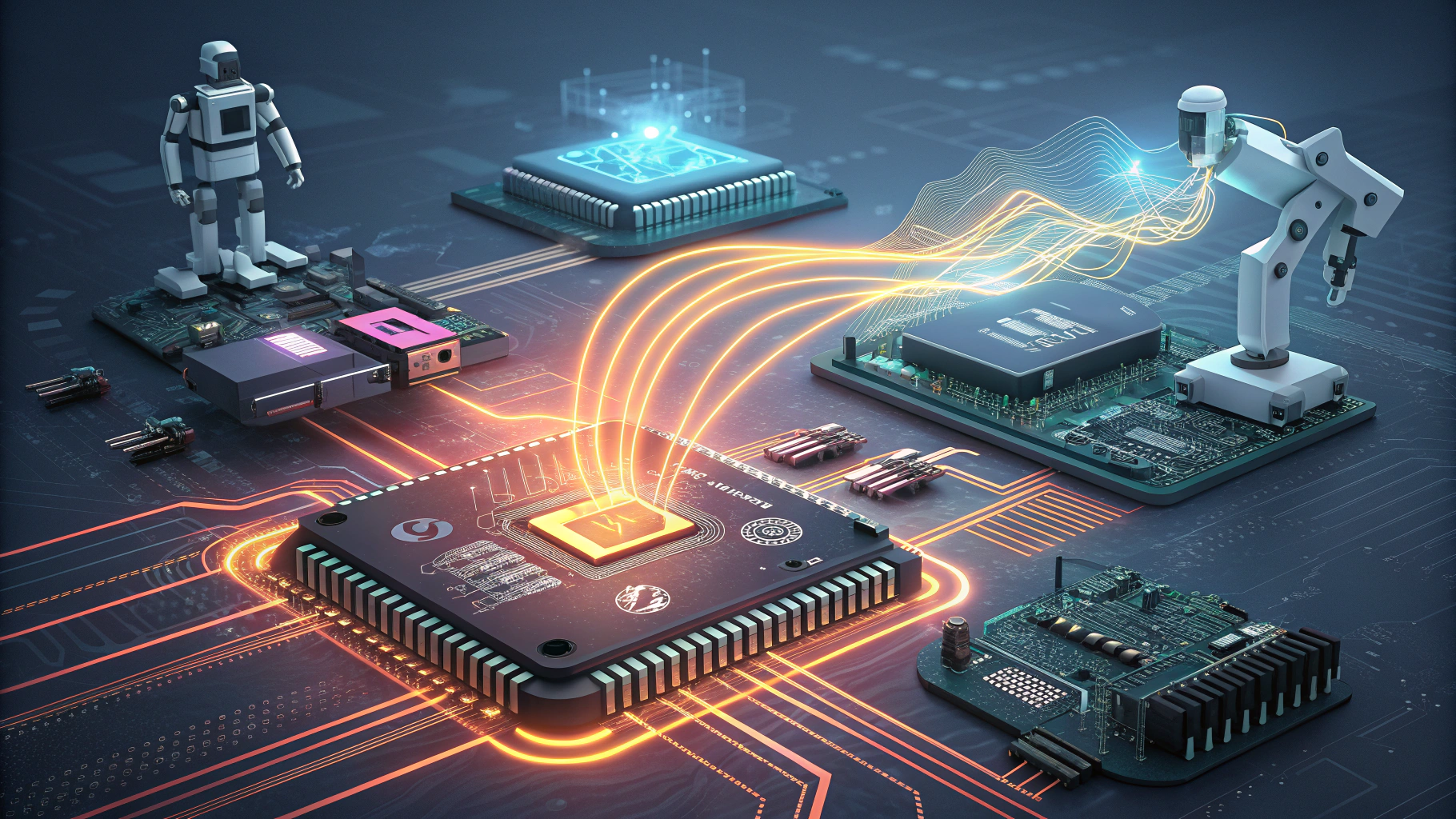
🔄 Edge AI: Where Hardware Meets Decentralization
Edge AI is the application of AI on local devices (sensors, cameras, wearables) instead of cloud servers. It brings:
- Lower latency
- Better privacy
- Reduced bandwidth costs
Edge AI would be impossible without dedicated hardware accelerators on each device.
Popular Edge AI Hardware Platforms:
- NVIDIA Jetson Nano / Xavier NX
- Google Coral TPU
- Intel Neural Compute Stick
- Qualcomm Snapdragon AI
🌍 In developing markets like Pakistan, edge AI is ideal where internet is limited but on-site intelligence is needed — in agriculture, security, health, and logistics.
🌐 Global Companies Investing in AI Hardware
- Google: TPUs powering cloud and on-prem AI workloads
- Apple: Neural Engine in every iPhone since the A11 chip
- Tesla: Custom Dojo supercomputer for autonomous driving
- Meta: Building its own ASICs for AR/VR and the metaverse
- Amazon: Inferentia and Trainium chips powering Alexa and AWS AI
💡 But it’s not just for big tech — open-source tools and affordable dev kits make it accessible for startups and developers, too.
🇵🇰 Why It Matters for Pakistan’s Tech & Business Sectors
- eCommerce: Personalized recommendations using AI on mobile devices
- Agriculture: Crop analysis via drones and smart sensors
- Energy: Real-time consumption monitoring in smart grids
- Education: AI-enabled devices for content translation and accessibility
- Logistics: Route optimization powered by edge AI
🚀 With access to AI-accelerated hardware, Pakistani startups can build globally competitive products — even with limited cloud infrastructure.
🛠️ Getting Started: Tools & Resources
Want to experiment or prototype smart systems? Start with these:
Developer Kits:
- NVIDIA Jetson Nano (AI on the edge)
- Raspberry Pi + AI accelerators
- Google Coral Dev Board
Frameworks:
- TensorFlow Lite: Optimized for mobile & edge
- ONNX Runtime: Works across chips (Intel, ARM, NVIDIA)
- OpenVINO (by Intel): For computer vision applications
Use Case Ideas for Local Developers:
- Urdu-speaking smart assistant
- Smart irrigation controller
- Real-time license plate reader
- Gesture-controlled home automation system
🎯 Hardware is no longer a bottleneck. It’s a launchpad for innovation.
🔮 The Future: Specialized Chips, Smarter Systems
- Smaller form factors with greater power
- Neuromorphic computing that mimics the human brain
- Quantum-AI hybrids for scientific research
- Green AI hardware for sustainable energy use
Whether it’s powering self-driving buses in Karachi or AI tutors in Peshawar, the intersection of AI and hardware will define how intelligent — and inclusive — our systems become.
Final Thoughts
As businesses and startups across Pakistan move toward automation, digitization, and intelligent decision-making, AI-accelerated hardware is the foundation enabling that future. It empowers smart systems to think faster, learn quicker, and act independently — in factories, hospitals, streets, and homes.
At Dreams Lab, we help organizations:
- Integrate AI into hardware products
- Choose the right edge AI platforms
- Build prototypes with smart sensors and accelerators
- Train teams on AI frameworks and edge deployment