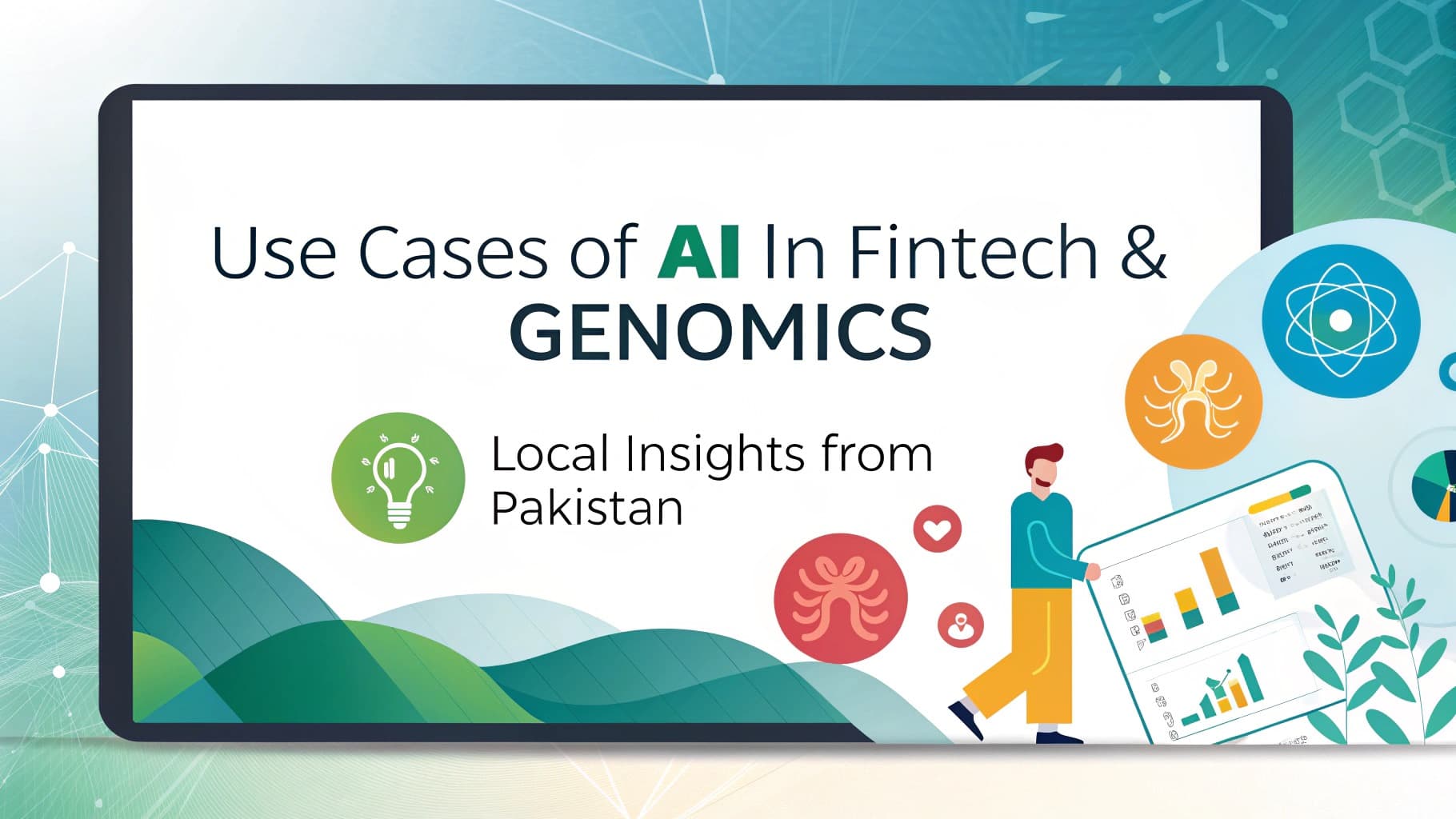
Use Cases of AI in FinTech & Genomics Local Insights from Pakistan
Use Cases of AI in FinTech & Genomics: Local Insights from Pakistan
By Dreams Lab
Artificial Intelligence (AI) is no longer a futuristic concept — it’s a present-day catalyst transforming industries at unprecedented speed. Two sectors where AI is making especially deep inroads are FinTech (financial technology) and Genomics. While they might seem worlds apart, they share one thing in common: data complexity that demands intelligent automation.
In Pakistan, both industries are gaining momentum. FinTech startups are redefining how people bank and borrow, while genomics labs are mapping DNA to fight inherited diseases. And powering both revolutions is AI — analyzing patterns, making predictions, and uncovering insights that humans alone can’t.
At Dreams Lab, we explore emerging tech that’s not just global but relevant to local realities. In this guide, we’ll highlight key use cases of AI in FinTech and Genomics, with a focus on local examples, needs, and future opportunities in the Pakistani ecosystem.
🤖 What’s Driving AI Adoption in FinTech & Genomics?
Both industries are:
- Data-rich (millions of transactions or genetic sequences)
- Pattern-driven (fraud detection or mutation tracking)
- Impact-critical (finance affects livelihood; genomics affects health)
That’s where AI excels — processing vast, complex data to uncover actionable insights faster and more accurately than traditional systems.
💸 AI in FinTech: Smarter, Safer, Scalable Finance
Pakistan’s FinTech sector has witnessed explosive growth in the last 5 years, with mobile wallets (like JazzCash, Easypaisa), lending apps, neobanks, and digital payment solutions serving millions. But behind the user-friendly apps is a layer of intelligence — increasingly powered by AI.
🔍 1. Fraud Detection and Risk Scoring
How it works:
- AI models analyze historical transaction patterns.
- They flag anomalies (e.g., sudden high-value transfer, login from new location).
- Automated alerts or blocks are triggered — in milliseconds.
Local Impact:
- Detect SIM-swap fraud
- Monitor atypical wallet-to-wallet transfers
- Prevent phishing through device recognition
✅ Benefit: Reduced fraud, faster resolution, greater customer trust.
💳 2. Credit Scoring for the Unbanked
Traditional credit scoring fails in markets like Pakistan where many users have no formal financial history.
AI changes that.
How it works:
- AI uses alternative data: mobile usage, utility bills, payment frequency, social behavior.
- Creates predictive models to assess creditworthiness for microloans or BNPL (Buy Now, Pay Later).
Local Example: FinTech startups like Tez Financial Services and CreditFix are leveraging AI to build credit models for low-income and underserved populations.
💡 AI enables financial inclusion by turning unconventional data into decision-making power.
💬 3. Conversational Banking & Chatbots
AI-powered chatbots are transforming how users interact with financial services.
Use cases include:
- Checking balance or transaction history
- Filing complaints or freezing accounts
- Loan application pre-screening
Tools Used:
- NLP engines like Dialogflow, Rasa, or ChatGPT APIs
- Urdu and Roman Urdu-based chat flows for better user accessibility
🎯 Local banks are deploying WhatsApp bots to reduce call center load and improve 24/7 support — especially for non-English-speaking users.
📈 4. Predictive Financial Modeling
AI can forecast:
- Loan default probabilities
- Stock price movements
- Cash flow for businesses
Using historical and real-time data, FinTech apps can now offer:
- Smart investment suggestions
- Spending alerts
- SME credit lines optimized by AI
📊 This is particularly valuable for B2B FinTech platforms serving Pakistan’s 3.3 million+ SMEs.
🧩 Bonus: AI in Regulatory Compliance
RegTech (Regulatory Technology) uses AI to automate:
- KYC (Know Your Customer) through facial recognition
- AML (Anti-Money Laundering) through suspicious transaction tracking
This enables faster onboarding and compliance with SBP guidelines.

🧬 AI in Genomics: From Gene to Cure
In genomics, AI is revolutionizing how we:
- Understand diseases
- Design treatments
- Predict risks
- Personalize care
Pakistan, with its high rate of inherited genetic disorders and consanguineous marriages, urgently needs scalable AI-powered genomics solutions.
🔬 1. Genome Sequencing & Pattern Recognition
Sequencing the human genome generates gigabytes of data per patient. AI helps:
- Clean and align DNA reads
- Identify single-nucleotide polymorphisms (SNPs)
- Detect structural variants
This drastically reduces time from weeks to hours in identifying possible mutations linked to rare diseases.
Local Context: Labs and universities in Lahore and Karachi are experimenting with open-source AI platforms like DeepVariant (by Google) to analyze genomic data from Pakistani populations.
📌 Genomic data from South Asians is underrepresented globally — AI can help local researchers build inclusive, population-specific models.
🧠 2. Predicting Disease Risk
AI models trained on genomic + lifestyle data can predict risk of:
- Cancer (e.g., BRCA mutations)
- Diabetes and metabolic disorders
- Cardiovascular diseases
By applying deep learning to genomic data, we can identify at-risk individuals before symptoms show up — enabling early intervention.
🩺 This is especially useful in rural screening programs and preventive medicine initiatives.
💊 3. Drug Discovery and Personalized Treatment
AI is speeding up the discovery of genotype-driven therapies, especially for:
- Rare genetic disorders
- Targeted cancer therapies
- Vaccine development
AI can also match patients with personalized treatments based on their DNA.
🧪 Pakistan-based clinical researchers are starting to adopt tools like IBM Watson for Genomics and AlphaFold (by DeepMind) to model protein interactions for drug targeting.
👨👩👧 4. Population Genomics for Public Health
With AI, governments can analyze large-scale genomic data to:
- Identify regional disease patterns
- Predict future outbreaks
- Inform health policy and vaccination drives
In Pakistan, where genetic disorders like thalassemia affect ~5% of the population, population genomics powered by AI could drive massive improvements in genetic counseling and policy planning.
🇵🇰 Local Opportunities & Challenges
🌟 Opportunities:
- AI democratizes access to finance and healthcare.
- Lower compute costs and open-source tools make adoption feasible.
- Pakistani startups in both sectors are increasingly data-aware and tech-forward.
🚧 Challenges:
- Data privacy laws are still evolving.
- Limited access to trained professionals in AI + genomics/finance.
- Infrastructure gaps in edge computing and secure data storage.
🎯 But with the right partnerships (industry + academia + policy), Pakistan can leapfrog traditional systems using AI innovation.
🛠️ How Dreams Lab Helps
At Dreams Lab, we work with startups, enterprises, and research labs to:
- Integrate AI into FinTech platforms (chatbots, risk models, automation)
- Develop AI pipelines for genomic data analysis
- Build local language NLP systems for better inclusivity
- Train teams on AI tools like TensorFlow, PyTorch, Dialogflow, and AutoML
💡 We believe AI should be applied with purpose, not just buzzwords.
✅ Final Thoughts
From predicting fraud in real-time to decoding the secrets of human DNA, AI is the thread weaving intelligence into systems that matter most — our money and our health.
In Pakistan, where innovation must meet scale, affordability, and impact, FinTech and Genomics offer the perfect intersection for AI-powered transformation.
If you’re building the next big thing in finance, health, or science, remember:
You don’t just need data.
You need intelligence from that data — and that’s what AI delivers.